CLASS OF 2015-2016

Saturday, March 15, 2014

GRADE 3 - MATH / TIME

 When teaching time, I find starting with the minutes is more beneficial than starting with the hour hand.  I have my student memorize the position of every 5 minutes on the clock.  This way, they understand where the minutes are on the clock before they are taught the very visible numbers assigned to the hour hand.

Materials :  Paper plate, bobby pins, cardboard, glue gun.


Everyday, my student places the 5 unit increments on the clock.  We also practice this kinesthetically with our bodies standing, using ourselves as the minute hand.

I adapted them a bit to include the hour hand exercises that you will read about as you scroll down.


Color coding the clock helps my student learn and follow the hour hand.   I also use the same kinesthetic exercises for memorizing positions of the numbers representing hours.  We practice rotating our bodies in a full circle from various starting points on the clock before we try it on a real clock.  We also count with our bodies by 5's, 10's, 20's and 30's.  


After positions of both sets of numbers of memorized,  and a review on fractions (quarter and half hours), I then teach how to tell time and elapsed time.  When counting elapsed time, I find that using a tally system to count hours and then a minute hand to count minutes work best.

GRADE 8 - PRE-ALGEBRA / Graphing


Students with specific learning disabilities can have difficulties with orientation when graphing.  So I use a kinesthetic approach to feel the motion of positive/negative, moving along the x and the y axis.


 Then, I color the x and x axis, so the student knows which line to follow first.  


GRADE 3 - MATH / Fractions of an inch


A simple, visual way to teach fractions of an inch…color the ruler!


GRADE 2 - MATH / Money


Students with learning disabilities can have extreme difficulty counting money.  So, these are the steps I used to scaffold learning.  First lesson, pre-teach coin values.  Student writes the value right on the face of the coin.


Second lesson, use blocks to represent coin values.


Student place corresponding blocks with coins of the same value.  
Student can then add blocks incrementally.


When quarters and half-dollars are taught, I use real coins...


and write the value with a sharpie on the back of each coin.
(Sharpies are erasable)


When counting money, the student can place the coin to match the pictures on the worksheet.
(I find student confuse nickels with quarters, so this is a useful technique)


Sunday, February 16, 2014

GRADE 2 - MATH / Fractions

Fraction Box

I have found that my young students with spacial/visual disorders have trouble with placement when it comes to fractions.  The fraction bar gets confused with many other lines on the page.  So I started using what I call a "Fraction box" to make it easier for them to understand that the part goes in the top box and the total goes in the bottom box.  


It's not a great stretch of the imagination, but the simple addition the the fraction bar really helps them visualize how the fraction should look.

GRADE 6-12 - WRITING / Lipograms

Lipogram

A Lipogram is a piece of writing with an omission of 1 letter.  

This writing assignment forces my students to use sentence variety and experiment with word choice.  At first, they think it's an impossible task, but after a bit of practice, they realize, not only is it possible, it is also fun!  My hope is that they will carry on this practice to their other writing assignments.  

Collage.

First, I have my students make a collage with images they are drawn to for whatever reason.  Here is an example from one of my 9th graders.


Write.


Second, I have my students write about their expression.  This can include an interpretation of the collage…why they chose the images, what importance they have, maybe representing their current emotional state and/or interests.   Here is my 9th graders interpretation.


Rewrite.


Finally, I have the students rewrite their piece without a selected letter.  In this case I chose the letter "i" because she began many of her sentences with that letter and I wanted to encourage her to experiment with different beginnings.  Here is her rewrite.


As you can see,  a couple of "i's" found their way into this write-up,  but it is an amazing transformation!  It presents quite a challenge.  I love this exercise!!

Wednesday, January 8, 2014

GRADE 2 - MATH / Window Adding

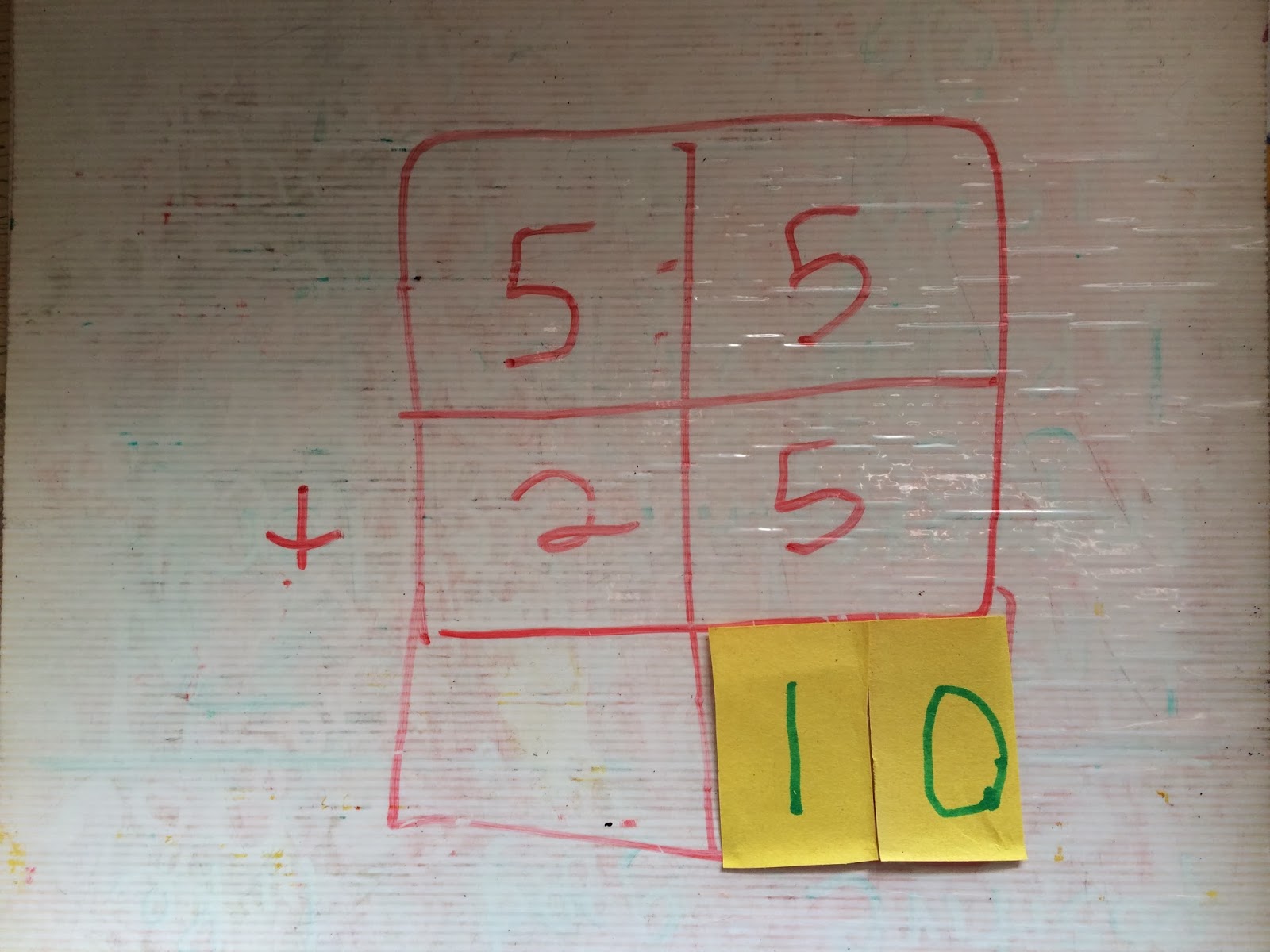
Some students have difficulty copying and aligning problems, so I have them write the numbers in a window.


The student adds the ones column and shows the answer with number cards.  The student can see that 2 digits should not be place in one box and carries the one to the tens column


like this...


The student then adds the tens column and shows the answer with a a number card again.


The student then prints the answer.


This tactile activity has been very helpful with my differential learner who gets very distracted using blocks and manipulatives.

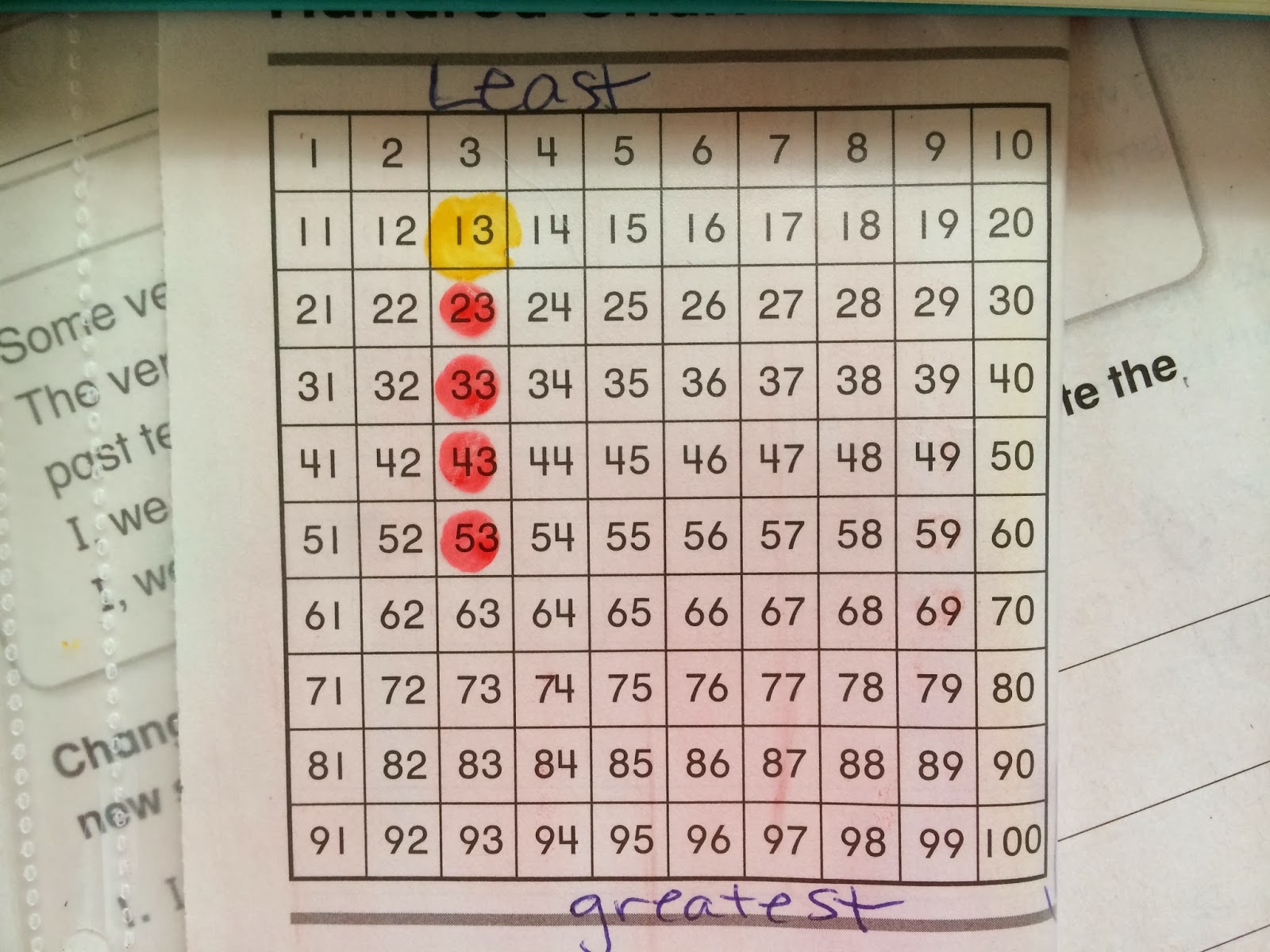
GRADE 2 - MATH / Adding Tens using a # Chart for differential learners


GRADE 3 - MATH / Create A Multiplication Facts Game

Making a game is a great way for your student to practice multiplication.  First I have the student draw a picture.  We usually brainstorm locations (Disneyland, The Zoo, Playground, School, Library, Market, Outer space, the Ocean, etc...  Then, the child chooses a location to draw.  This student drew items in a toy store.  The drawing can be as elaborate or as simple as the student prefers.

Then, I add the route which travels the board including some of the drawings.  I write in the multiplication facts that the student is working on and add every week addition facts until all are on the board.  I may add repeats for the difficult facts.


The yellow spaces mean "pick a card."  I have the student write out cards that take you to different spots on the route (here's where the drawing comes into play).  I added a few cards shown in green…just to make it fun!

Roll the die and learn those facts!  

Tuesday, November 12, 2013

GRADE 3 - MATH / Relating Multiplication and Division

Students practice relating multiplication to division on the whiteboard.  So easy!


I color code the model.  The red factors become the divisor and quotient.  The green product becomes the dividend.


Students use number cutouts for practice.


After moving the numbers, students read the equation.


Saturday, October 26, 2013

GRADE 8,9,10 - MATH / ALGEBRA, Graphing Slope Intercept Form

My Algebra 1 student was having trouble graphing equations from Slope Intercept Form so we practiced identifying slope and y-intercept by transferring problems from the book to this work mat.  We made cards representing the slope and y-intercept and identified which was which.  The template shows the student what to graph first (You can see the "Start Here").  Then the student can also very easily find the slope.


Underneath the card, I have notes, definitions and instructions to help the student.  Ex: slope is rise/run.


I refer to the slope as the "M"ountain slope, so that they remember that the "m" represents the slope.

GRADE 1 - ELA / Neighborhood unit activity

This is a great Social Studies/Geography activity I found on Pinterest.  It can be used in 1st grade when discussing neighborhoods as a theme for ELA.


My first grader created this one.  I helped out by printing out maps of our state and continent.  We included circles for her house, street, city, state, continent, planet and world.

GRADE 1 - ELA / Rhyme activity for Green Eggs and Ham

I found these non-toxic foam pieces at the fabric store.  You just use water to stick them together!

So I wrote out rhyming words for my Green Eggs and Ham lesson for my 1st grader.  I had her practice pairing the rhyming words for a few days and when she was confident she could read all the words and find the rhyme, she stuck the pairs together with water.


I let her keep the pairs in a jar and she was so excited to read them to me every day!  And, when it came time to read the story, she knew all the words!!

GRADE 2, 3 - ELA / PARAGRAPH CONTENT, Which sentence doesn't belong?


To accomodate students who are special needs, I hand-wrote in a journal book, some of the paragraphs form the Evan-Moor  Paragraph Writing Workbook.  I then, cut underneath each sentence but left it attached to the book on the left side.  One sentence does not belong, and all the student has to do is tear out the sentence.  They can, then, read the complete paragraph w/o the sentence that doesn't belong.

GRADE 2 - MATH / EVEN NUMBER PATTERNS


I had my 2nd grader write out the even numbers in columns as shown above and then color code the patterns.  This is a great method for visual learners.  The student can see that the number on the left of each column repeats and the numbers on the right all count 2, 4, 6, 8, 0.