Some students have difficulty copying and aligning problems, so I have them write the numbers in a window.
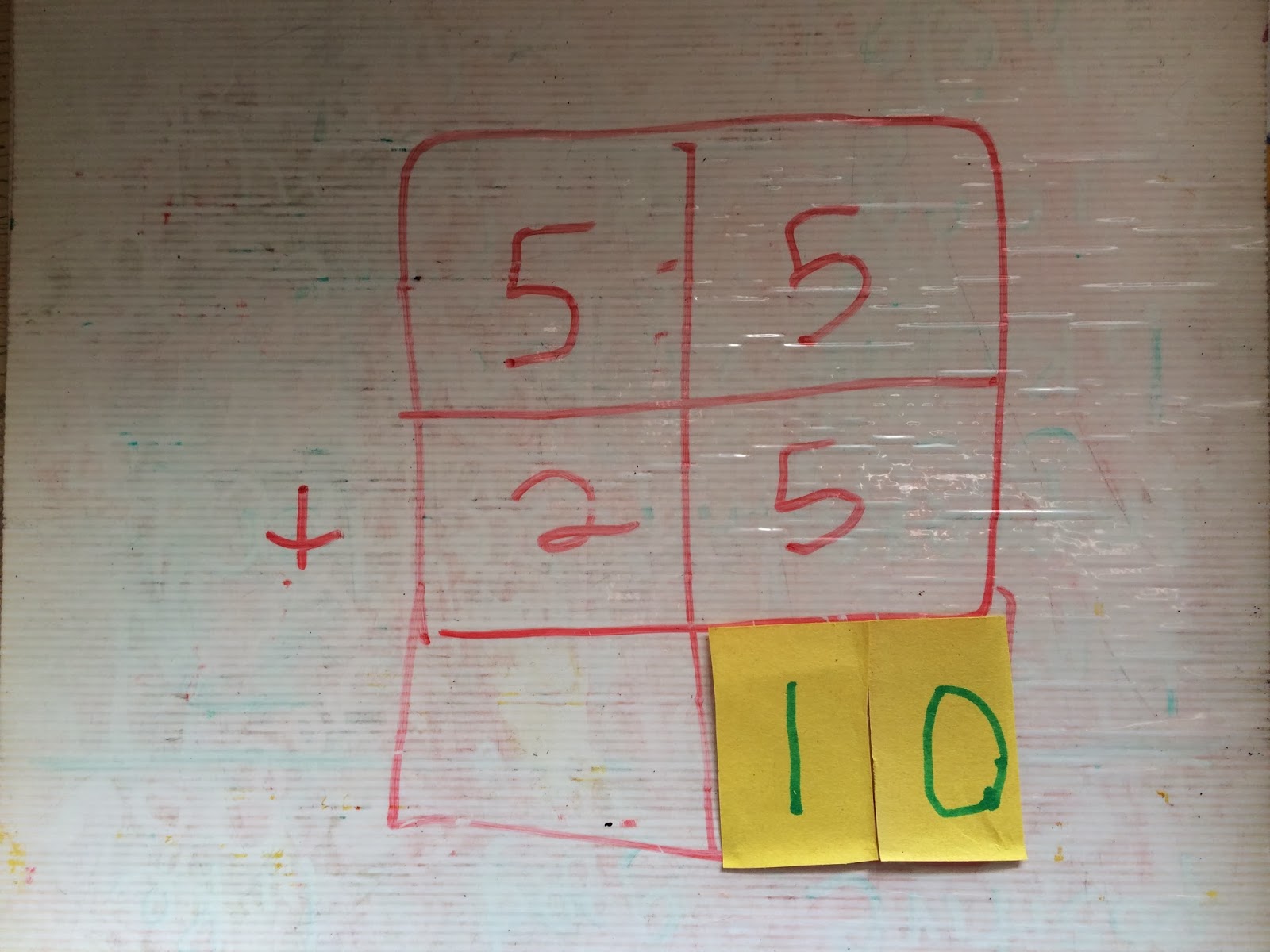
The student adds the ones column and shows the answer with number cards. The student can see that 2 digits should not be place in one box and carries the one to the tens column
like this...
The student then adds the tens column and shows the answer with a a number card again.
The student then prints the answer.
This tactile activity has been very helpful with my differential learner who gets very distracted using blocks and manipulatives.
Younger students often have difficulty with algebra problems. For example 3 + ___ = 10.
so I use a technique which I call the "Build the Ladder" to help them discover the answer.
Students place the number of blocks down that they know in the "I have" section. In this case 3 blocks.
They right the total number that they have to count up to in the box which is labeled "Stop" to remind them to stop counting.
Here you see the rungs of the ladder drawn on as the student counts 1,2,3 (from the blocks)......4,5,6,7,8,9,10 (on the ladder).
The student then counts the number of rungs on the ladder to find the missing part....7.
I'm a big fan of the white board and my students love working on them too!
Counting on is a difficult skill for some students, especially if they have a learning disorder. I created this mat for scaffolding. The student can see where the big number goes, and can also see that he/she must count the remaining (little) numbers on the fingers.
I made cutouts of numbers to place in the head part of the drawing. And students use blocks to put on the fingers. Here is an example of 8 + 3 = 11. It is great for visual learners.
After they have mastered the skill in this way, I transfer the concept so that the student is putting the big number in his own head or in his mind and I have him put the blocks on his real fingers to help count. Note that part of the counting is still visual.
Eventually, I have students put the big number in their mind and count on fingers w/o the block.
I discovered this addition technique through pinterest and think I will try it with my 3rd grader as an another addition strategy. We will be adding two and three 4 digit numbers. The only problem I foresee is if the columns aren't aligned properly. So, I will have her practice placement of numbers with index cards and use tape to align columns if there is a problem. Then I will have her try it on paper and see if she can transfer the method.
9-22-13
In reviewing the lesson, I think this is a good technique for the kids to learn. My feeling is that it should be learned in 2nd grade before the traditional algorithm for addition is taught.
I first had her try it using stickies. I used straight edges instead of tape for lines so that I didn't ruin her table...
When she demonstrated understanding, I had her try it on the white board...
My student showed good understanding. There was some practice needed to put the digits in the right columns as I anticipated.
So, I generated on the spot, grid lines to help her.
She did an excellent job and even reviewed the skill of relating addition to subtraction at the bottom.
Written directions would have been helpful, so here they are for the next time I teach the lesson.
Directions for ADDITION STACKING:
Add the digits in the ones column. If the answer is one digit, put it in the ones column on the first line. If the answer is two digits, put the answer in the tens and ones column on the first line.
Add the digits in the tens column. If answer is one digit, put it in the tens column on the second line. If the answer is two digits, put the answer in the tens and hundreds column on the second line.
Add the digits in the hundreds column. If the answer is one digit, put it in the hundreds column on the third line. If the answer is two digits, put the answer in the hundreds and tens column on the third line.
Add the digits in the thousands column. If the answer is one digit, put it in the thousands column on the fourth line. If the answer is two digits, put the answer in the ten thousands and thousands column on the fourth line.